Your first rental unit doesn’t need a $300/month enterprise platform. It also doesn’t need a spreadsheet.
The gap between those two options is where most small landlords get stuck — either overpaying for tools built for 200-unit management companies, or managing rent payments through Venmo and lease renewals through text messages until something breaks.
This guide covers the platforms worth using when you’re managing 1–20 units, what each one actually costs, and how to pick the right one based on where you are in building your portfolio.
What Small Landlords Actually Need from Software
Before getting into platforms, here’s the short list of what matters at 1–20 units:
Online rent collection. The single highest-leverage feature in property management software. Automatic ACH collection, late fee triggers, and payment records eliminate the most common landlord-tenant friction and cut your bookkeeping time in half.
Tenant screening. Background check, credit report, eviction history — either built-in or integrated with a screening provider. Running screens through the software keeps records in one place.
Lease management and e-signatures. Customizable, state-specific lease templates with e-signature capability. Critical in California given how specific CA landlord-tenant law is on required disclosures.
Maintenance request tracking. Tenants submit requests through the app; you have a record. This matters more than it seems — undocumented verbal maintenance requests become disputes.
Basic accounting. Income and expense tracking, receipt scanning, and export to Schedule E format for tax time. You don’t need QuickBooks integration if the platform does this natively.
What you don’t need at 1–5 units: Owner portals, multi-user access, vacancy posting syndication to 50 sites, AI lease analysis, dedicated account managers, or per-unit pricing that assumes a 50-unit minimum.
The 5 Best Platforms for Small Landlords in 2026
1. Innago — Best Free Option (Best Overall Under 10 Units)
Price: Free for landlords (tenants pay screening fees)
Units: Unlimited
Rating: 4.9/5 on G2 (500+ reviews), 4.9/5 on Capterra
Best for: Landlords starting out; 1–10 unit portfolios; investors who want solid fundamentals at zero cost
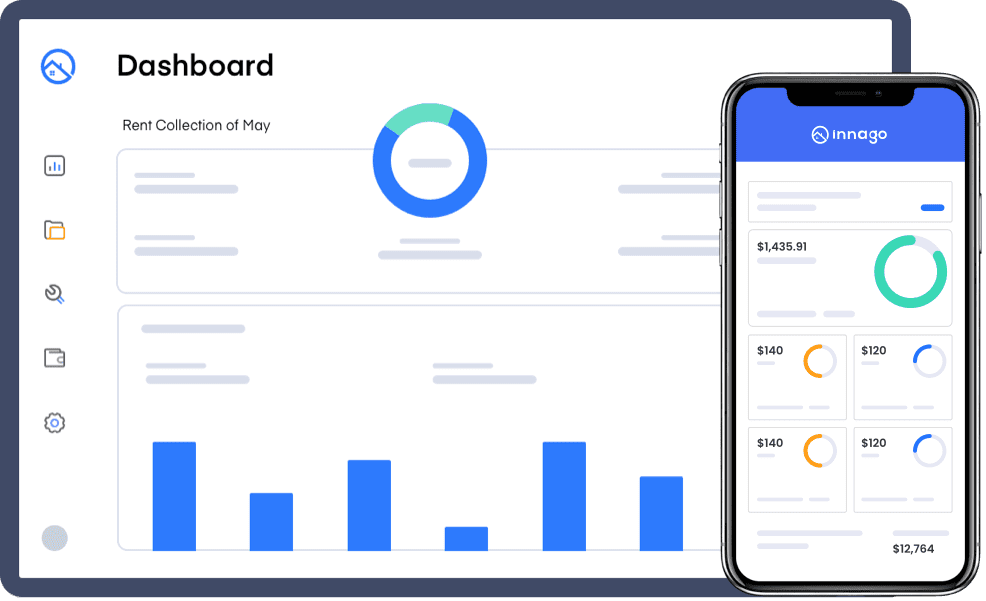
Innago is the most highly rated property management platform in its category — consistently scoring above 4.9 across review platforms with an overwhelmingly positive sentiment. The free-for-landlords model works because Innago charges tenants for screening reports and passes credit card processing fees to them, not you.
Core features included free: online rent collection (ACH), tenant screening, lease management and e-signatures, maintenance request tracking, and tenant communication. Everything a small landlord needs to manage units professionally is in the free tier.
The platform is almost entirely small-business focused — nearly 100% of G2 reviews come from small landlords — which means the product development is aligned with your actual use case, not a large property management firm’s workflow.
Limitation: Innago is feature-complete for fundamentals but lighter on accounting and tax reporting than Stessa or Baselane. If detailed financial reporting is a priority, combine Innago with Stessa (also free) for accounting.
2. Stessa — Best for Accounting and Tax Reporting
Price: Free (core); Pro plan ~$20/month
Units: Unlimited on free tier
Best for: Landlords who want clean financials; BRRRR investors tracking ROI; anyone prepping for Schedule E
Stessa is used by over 350,000 investors and is rated the #1 landlord app based on App Store ratings and total reviews as of early 2026. The platform’s core strength is financial tracking — it automates income and expense categorization, scans receipts, and generates reports that export directly to Schedule E format for tax time.
For a BRRRR investor building a portfolio and tracking return on individual properties, Stessa’s asset-level reporting is genuinely useful. You can see net operating income, cash-on-cash return, and equity position per property in real time.
The free tier covers most of what a small landlord needs — rent collection, basic expense tracking, tenant screening, and lease storage. The Pro plan adds automated rent reminders, advanced reporting, and priority support.
What Stessa is not: a full operations platform. Maintenance request tracking is basic, and it lacks some of the tenant communication features that Innago or TurboTenant offer. The right model for many small landlords is Stessa for financials + Innago for operations.
3. TurboTenant — Best for Finding and Screening Tenants
Price: Free (landlord); Premium ~$10–$15/month
Units: Unlimited
Rating: 4.5/5 on G2; 4.6/5 on Capterra
Best for: Landlords with frequent vacancies; BRRRR investors turning over units; anyone who markets their own rentals
TurboTenant’s strongest feature is vacancy marketing and tenant sourcing. Free listings syndicated across major rental sites (Zillow, Apartments.com, Rent.com), combined with built-in screening that includes background check, credit report, and eviction history — all in one flow from listing to signed lease.
For a landlord managing a BRRRR conversion who needs to find and screen a tenant quickly, TurboTenant streamlines the front end of the process better than most platforms at this price point.
The premium tier adds e-signatures on lease documents and a few additional features. At $10–$15/month, the upgrade is reasonable if you’re actively filling vacancies. On a stabilized property with a long-term tenant, the free tier is enough.
What TurboTenant is not: a strong accounting platform. Financial tracking is basic. For tax reporting, pair it with Stessa.
[Start Free with TurboTenant →]
4. Baselane — Best for Banking + Property Management in One
Price: Free
Units: Unlimited
Best for: Landlords who want to separate business banking from personal; investors building entity structures (LLC)
Baselane is the only platform on this list that combines a dedicated landlord banking account with property management software. If you’re operating through an LLC — which you should be before your first deal — Baselane lets you set up business banking, collect rent directly into dedicated property accounts, and track income and expenses per property, all in one place.
The banking integration is the differentiator: rent payments deposit directly into Baselane accounts, expenses get categorized automatically, and the reporting is built around property accounting rather than general household finance.
For a new investor building the right financial structure from the start, Baselane solves a real problem — most new landlords run rental income through personal accounts and then recreate transaction records at tax time. Baselane eliminates that.
Feature depth for tenant operations (maintenance, communication) is lighter than Innago or TurboTenant. Best used as your financial hub paired with one of the operations-focused platforms.
5. DoorLoop — Best Paid Platform for Growing Portfolios
Price: ~$69/month (Starter, up to 20 units)
Best for: Landlords scaling from 10–50 units; investors who want an all-in-one platform and are willing to pay for it
DoorLoop is the most feature-complete platform on this list — rent collection, tenant screening, maintenance, accounting, owner portals, lease management, and reporting in one product. If you’re managing 15–20 units and the free-tier patchwork (Innago + Stessa + TurboTenant) is creating friction, DoorLoop is the upgrade path.
The monthly cost is real — $69+/month is $828/year, which is meaningful at 5 units but less so at 20 where the per-unit cost drops to under $4/month. At scale, DoorLoop competes favorably with AppFolio and Buildium on price while being more accessible for smaller portfolios.
Do not start with DoorLoop if you’re managing 1–3 units. The free options cover everything you need and the $69/month is hard to justify at that scale. Add DoorLoop to the stack when the free platforms start creating operational friction — that’s when you’ve outgrown them.
Platform Comparison Table
| Platform | Price | Rent Collection | Screening | Accounting | Maintenance | Best For |
|---|---|---|---|---|---|---|
| Innago | Free | ✓ | ✓ | Basic | ✓ | 1–10 units, all-around free |
| Stessa | Free / $20 mo | ✓ | ✓ | Excellent | Basic | Financial tracking, tax prep |
| TurboTenant | Free / $15 mo | ✓ | ✓ | Basic | Basic | Vacancy marketing, screening |
| Baselane | Free | ✓ | Basic | ✓ | Basic | LLC banking + finance |
| DoorLoop | $69+ mo | ✓ | ✓ | ✓ | ✓ | 15–50 units, all-in-one |
Which Platform for Your Stage
Deal #1, first tenant, figuring it out: Innago (free, highly rated, covers everything you need). Add Stessa if you want cleaner financial reporting from day one.
3–5 units, frequent vacancies, doing your own leasing: TurboTenant for sourcing and screening + Stessa for accounting.
Building an LLC structure, want clean financial separation: Baselane as your banking and financial hub + Innago for tenant operations.
10+ units, portfolio growing, starting to feel the friction of multiple tools: Evaluate DoorLoop. The consolidation value is real at that scale.
What you should not do: Use AppFolio or Yardi. Both are excellent platforms — for management companies running 200+ units. The minimum monthly spend ($280–$400/month) and the product complexity are designed for a professional property management firm, not an investor building a 5–10 unit portfolio. You’ll pay for features you can’t use and spend weeks learning software that was never built for your use case.
A Note on California-Specific Compliance
California landlord-tenant law has specific requirements that affect how you use any of these platforms:
Lease disclosures. CA requires specific disclosures in residential leases (mold, lead paint, Megan’s Law, etc.). TurboTenant and DoorLoop both offer California-specific lease templates that include required disclosures. Verify any template you use is current before signing — CA legislature updates landlord-tenant requirements frequently.
Rent control. If your property is subject to AB 1482 or local rent control (LA, Santa Monica, Oakland, etc.), your software needs to track annual increase limits and proper notice timelines. DoorLoop handles this more robustly than free-tier platforms.
Security deposits. CA limits security deposits to 2 months rent (unfurnished), with strict return timelines and itemization requirements. All platforms let you track deposit amounts; make sure your move-out documentation process is built into your workflow regardless of which tool you use.
Disclosure: FlipperGrade.com uses affiliate links and may earn a commission if you sign up through links on this page. We only recommend platforms we’d use to manage our own rentals.